30 September 2007

Lucania and Padre Pio

We spent last week visiting Lucania, the home region of Valerie’s great-grandparents. On a map you will find Basilicata but the people of that region prefer to be called Lucanians, reflecting their heritage. Basilicata was known as Lucania before the government changed the name over a hundred years ago.

We saw a lot, ate a lot and had a great time visiting with family and I am going to break-up our trip into a couple parts. This first part covers our first few days in Puglia and Lucania when we stopped by San Giovanni Rotondo on the Gargano Peninsula; this is the hometown of San Pio da Pietrelicna, commonly known as “Padre Pio”. We were there the day before his feast day and the town was packed with pilgrims, paying homage to this priest so strongly revered in southern Italy. The country side is dotted with olive groves and is a dry rocky area.

We then headed into the rolling hills of Lucania and spent the night in Genzano di Lucania. This is a town where most of the centro storico has been abandoned for newer housing after earthquakes over the years have weakened many buildings. Some people were starting to do work in the centro but there still is a lot to be done. There are many towns in this area with a similar history of abandoning the old for the new.

The countryside in this area is rolling hills covered with wheat fields that have recently been plowed interspersed with vineyards and olive groves. There are few towns and houses dotting the hill sides as well as little industry so the views are crisp and clear.

The next day we drove over to Castel del Monte, I think one of the most striking castles in Italy as it sits on a hill overlooking the countryside of Puglia. This is one of several built or used by Federico II in the 13th century in this part of Italy. The octagonal limestone shape is very unique and despite it remote location there were many visitors speaking a variety of languages.

We then headed on to Matera

26 September 2007

Panorama Italy 2008 tour dates

Panorama Italy tours

For those of you who have found this blog by searching for information on Ascoli Piceno, our adopted hometown, be sure to check out our tour website. We have added dates for tours for 2008 for those getting a start on planning their vacation for next year. You can visit Panorama Italy at www.panoramaitaly.com and contact us about customized tours by email at tour@panoramaitaly.com.

24 September 2007

Basilicata again…

We are headed back to Basilicata this week to meet up with Valerie’s cousin Celia in Matera for a few days and then we are all going over to Anzi together. This is the hometown of Valerie’s great-grandmother. Celia and Valerie’s Italian cousin Michele and his family always give us a warm welcome in Anzi.

We have never been to Matera and will also visit some new locations on our way down such as San Giovanni Rotondo, the hometown of Padre Pio.

21 September 2007

lingua italiana

Language lessons continue...

I have written before about learning Italian and I continue to struggle with my linguistic skills. I took a few classes before we moved to Italy but with one or two classes a week I never got beyond the basics. Last summer we came to Ascoli Piceno for a two week intensive class and while Valerie was in the advanced class I was placed in a beginner’s class. Since then I have tried a combination of ways to improve my Italian with some self-study and periodically having individual lessons with our friend Linda. I still have a long way to go to catch up with Valerie.

These past two weeks I have been taking another intensive group course and my classmates are here for a brief time from the San Francisco area. I did feel a sense of accomplishment when I was told I would be placed in an intermediate class, I guess I have learned something in a year.

I think the first few days my classmates were under the impression I was more advanced than I actually am. There are many things I have learned just from simple repetition such as answering where I am from, what I did for work in the US, why we moved to Ascoli Piceno, etc. I also might have a better ear for the local speech and some of the words and phrases that are unique to life in Italy. My fear of spitting out words may be less than my classmates but I assure them that their grammatical knowledge is superior to mine. We help each other with words or conjugations that we might struggle with and I think we are all improving each day.

Once this class ends I will still need to continue to work on improving my Italian, the daily interaction with locals helps but I do need to expand my vocabulary.

18 September 2007

Pasta or gasoline...

Pasta strike

Last week there was an event in Italy that I think helps to symbolize some of the differences there are about life in Italy versus the United States – there was a nationwide pasta strike. I studied economics when I was in college and have always had an interest in financial issues. Many times these issues can be much more complicated than the media may make them and thus I think many times many people have a misconception of the things that really affect their lives.

For example, in economics there is always the discussion of inflation as one of the gauges an economy but for many people this is a concept they do not completely grasp. However, Americans understand the price of gasoline completely. I recall that the newspapers in Albuquerque weekly listed the prices of a gallon of gas locally and statewide. When there was a change in the price of gasoline this would many times be the lead story for the evening news both on a local and national basis. If you asked any person on the street they could probably tell you the price of a gallon of gasoline within one or two cents.

During last week’s pasta strike people were encouraged to refrain from buying pasta for one day as a complaint about the price of pasta. In America I had heard of “gas strikes” but never a food strike because of the price. Based on what I see in the newspapers and what people discuss it seems that here the economy is gauged on the price of food, not on the price of oil. I have seen many articles on the price of pasta, bread and a cup of coffee but very few on the price of gasoline. To me this is very indicative of the differences of the lifestyles of Italians and Americans.

In Italy, food reigns supreme.

15 September 2007

Grape harvest season

la Vendemmia

Now is the grape harvest season in Italy and also in our home state of New Mexico. With the drought Italy is experiencing the grape harvest is expected to produce a reduced volume of grapes but a superior quality of wine. Some grapes were harvested in late August and different varieties will be harvested in the next few weeks. Many of the prime wine producing areas in the Piceno area have their wine feste this time of year to celebrate the harvest.

Our friends Bob & Maria who live in New Mexico have a small vineyard and each year they have a genuine vendemmia, where friends help to pick the grapes and everyone joins in for a big Italian feast afterwards. They have already harvested some of the grapes themselves and this week-end they will have a lot of extra hands to finish this project. The fall before we moved to Italy we had the opportunity to help with their harvest and enjoyed the hard work, good friends and the feast.

13 September 2007

English speakers in Ascoli Piceno

E Sua cognome Schneider?” I was in the biblioteca last week to post a sign on the billboard offering to give English lessons and had asked to make sure this was allowed. The man at the desk presented me with this question and I gave him a surprised look as he certainly did not look familiar to me. He explained in broken English that he has been corresponding via email with distant relatives in the Philadelphia area and that they directed him to this blog; he had recognized me from my photo. He said he enjoyed reading an American’s view on life in Ascoli Piceno.

This encounter is a good example of some of the interactions we have had with English speaking people here in Ascoli Piceno with a foreign connection. This summer I was at Pasticceria Guido when a man came in who definitely looked like a foreigner. He did his best to ask Assunta, the barista, where he could buy a hand fan for his wife. Assunta gave me a puzzled look as she did not understand his English, so I asked him if I could help give him directions. After talking a little he explained that he and his wife had been using the notes Valerie wrote for SlowTrav.com to see the sights in and around Ascoli Piceno.

There are a few English speaking foreigners residing here in Ascoli Piceno but you usually have to search to find them. The University of New Hampshire has a program based here and earlier this year we had the opportunity to spend some time with Mara and her husband, Peter, who were here for six months while Mara was teaching. We have met up with others from the school, including Jesse who found Valerie’s blog and wrote to her before arriving this summer. Jesse appreciated the information that we could provide, in English, about Ascoli Piceno. We have also met the department head for this school year’s program, Piero, his wife Karen who, along with their three kids are here for the entire year. Their kids are much more fluent in Italian than we are.

Unity College from Maine has had a periodic program here and we met Diane from that program. She had returned to Ascoli for most of the summer break. Diane’s passion is research on Cecco, Ascoli Piceno’s famous medieval poet, and she is has a wealth of knowledge on the background of this region.
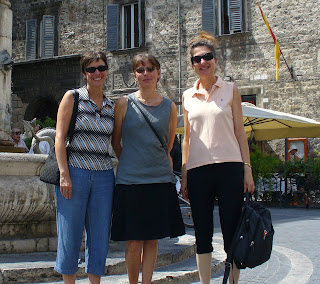
Thomas and his wife, Romina, from B&B Torretta Bianca found our blogs and we have visited them at their place in the hills above San Benedetto del Tronto. Thomas is an American with a passion for college football to match my own and Romina is native to this area.

Then there is the local British contingent. We have met Jane and Howard who spend several months at their home in the centro storico when they are not back in England and they are always a pleasure to chat with over a glass of wine. Colin is another retired Brit who lives here full-time. The mother of one of my classmates from language school last summer also lives here full time and we see her periodically on her bicycle. We may speak the same language but it is always interesting to compare the differences and similarities between England and the United States with all of them.

10 September 2007

Don't look in the mirror!

Driving fast


When I was younger I tended to drive too fast but changed that habit during my sixteen years handling insurance claims. This was for two reasons: financial and experience. I had a company car and excessive moving violations were a reason for losing your car privileges. I also saw first hand the direct results of reckless driving while inspecting damaged vehicles, visiting the injured in hospitals and the families of the deceased while investigating claims. Valerie frequently pointed out that I drove slower than many of the people on the highways who were passing me 10 or more miles over the speed limit.


Here in Italy speed limits and traffic laws appear to be mere suggestions. I have learned to adapt my driving to my surroundings and find the high intensity driving you experience here to be enjoyable at times. But I still find that Italians go too fast. To avoid frustration there are times I ignore my rearview mirror and the car behind me who is impatiently riding my bumper. Trying to follow an Italian in another car can be an adventure in high speed curves.


Their speed in a vehicle is a contrast to so much of the Italian way of life. We have experienced many things that take twice as long or longer than we experienced in the US but not driving speeds. On sidewalks I find myself usually walking faster than the locals. In a car I find myself being passed on curves, at intersections and on hills.


The best explanation I can provide for this Italian desire for speed is related to the fact that Formula 1 and motorcycle racing are big time spectator sports here. Anytime there is a televised race you will find every TV in a bar or restaurant surrounded by people mesmerized by the glow of the screen.


When you take an Italian who has leisurely enjoyed a two hour lunch and put them in a car, watch out as they will drive like they need to make up some of that lunch time getting home for riposo.

So when in Italy remember defensive driving is your safest way to avoid an incidente.


07 September 2007

Ghost town

Faraone

In Italy there are many charming hilltop towns bustling with life, but there are also a few that are abandoned, many times for newer suburban sprawl. One such town is Faraone which is up in the hills just south of Ascoli Piceno in Abruzzo. This is the hometown area of our landlord Guerino and he still has a plot of land and a small house in a nearby borgo.

This town was abandoned around the time of World War II when the government built Faraone Nuovo in a nearby field with typical fascist style buildings. The old town with its fortified walls and stone gate are hidden by trees but are a jewel for those who know where to look. We would not have found it if Guerino’s brother Angelo had not taken us there.

The only structure that is still complete is the church in what would have been the main square. Most of the other buildings are without roofs and vandals have caused damage to many buildings. Angelo showed us places where people would remove structural parts from these old buildings to incorporate into their new concrete houses. According to Angelo this abandoned town was used for some movie sets in the 1950’s, now it would only be useful as a derelict city.

There are many interesting architectural aspects of this town and it shows how quickly an area can deteriorate once it is abandoned. I am sure other regions of Italy have similar locations; you just need to know where to look.

06 September 2007

"alla Romana"

Coffee etiquette.

Since moving to Ascoli Piceno there are a couple things we have noticed that apply to the coffee bars. The first is that if someone invites you to have a café at a bar they will expect to pay. Here in Ascoli Piceno I have noticed that when locals invite me to have a café or drink with them they assume they are paying and do not appreciate it if I try to pay for mine or both.

At Caffe Pretoriana around the corner from our apartment we have a little game going on with some of the locals. Our landlord goes there for his after-lunch café and if I show up at the same time he will want to buy me a café. There are also two friends who are older gentlemen who go in a couple times a day and they have pre-paid several times for a café for me and Valerie. If I want to buy them a drink I must pay for it before they arrive. Gianluca, our friend the barista, enjoys these games and he is very good at keeping track of the receipts of who has paid for whom.

We have also noticed that if someone invites you to go out for dinner or lunch again they will expect to buy your meal. Unless of course everyone agrees before that you are going “a Romana”. You don’t go “Dutch” in Italy, but “Roman” when everyone pays for their own.

Just some of those little differences in cultures that it can be helpful to be aware of.

04 September 2007

Piove!

Rain, rain, oh what glorious rain!

It has finally rained here in Ascoli Piceno. After a week of fires all around the Piceno area and a couple days of promising clouds with nothing but dry winds we finally have rain. From our years in Albuquerque we know the experience of weeks without any moisture but the drought this summer has been unexpected and unusual.

We continue to have water shortages, many nights our faucets run dry by 10PM, and these are expected to continue through September. Hopefully the rain will continue for several days and the area will find some relief to the wildfire dangers and the water shortage.

Piove, Piove!

03 September 2007

Terremotti

Tremors

Italy is a country with a lot of mountains. Many people have a view of ancient cities and rolling hills but the Apennine Mountains run the length of the peninsula from top to bottom. Where there are mountains there will be earthquakes and Italy certainly has a history of earthquakes. There have been many over the history of this peninsula that have devastated entire towns.

The area around Ascoli Piceno has earthquakes, or terremotti, rather frequently. By that I mean we have felt probably seven since we moved here last September, including one last week. By chance it seems that many occur during the night but there have been a few during daylight hours. We have not seen or heard of any damage from these but you can see damage to buildings from past events throughout the region. The ones we have experienced have registered around 2.0 on the Richter scale, which is considered minor.

Having a degree in geology I am familiar with the mechanisms of earthquakes and also experienced the devastation that an earthquake can cause while helping people put their lives back together in Los Angeles after the Northridge Earthquake of February 1992. Here in Ascoli Piceno terremotti are just a part of the daily life.

The Istituto Nazionale di Geofisica e Vulcanologia has a good website where you can see where earthquakes have occurred as well as their magnitude. The graphics are good enough that no knowledge of Italian is required to figure out where there are earthquakes in Italy and how severe they have been.